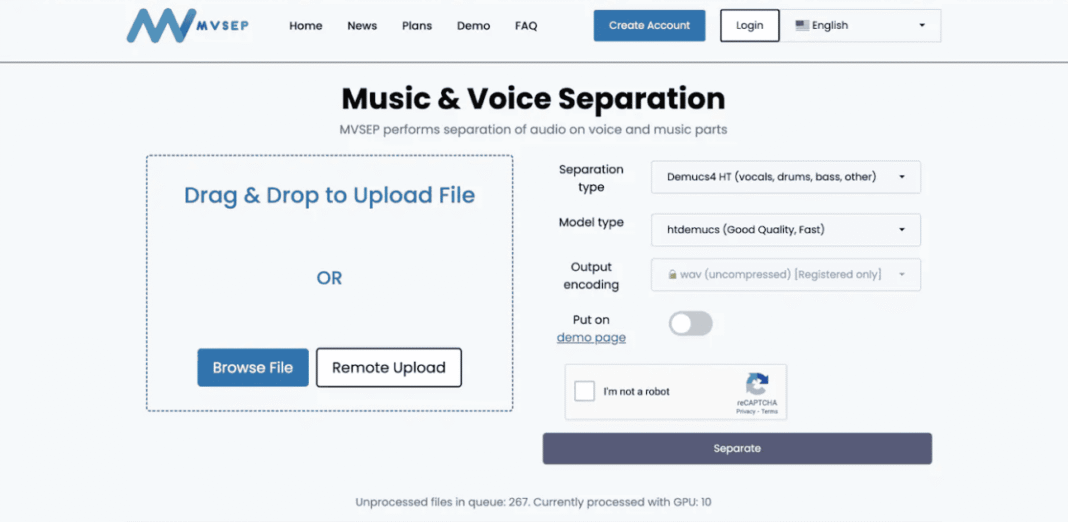

In the ever-evolving landscape of music technology, few tools have made as profound an impact as AI-powered audio separation. For musicians, producers, DJs, and audio enthusiasts, the ability to deconstruct a finished song into its core components—vocals, drums, bass, and other instruments—was once a distant dream. Today, it’s a reality, and at the forefront of this revolution stands MVSEP.
As we move through 2025, MVSEP has solidified its position not just as a tool, but as an indispensable platform for creative audio manipulation. This comprehensive guide will explore what MVSEP is, how it has evolved, its powerful features, and how you can use it to unlock new realms of creativity in your projects.
What is MVSEP? Demystifying the Magic
MVSEP (which stands for Music Voice Separation) is a free, open-source, and web-based platform that leverages advanced artificial intelligence and machine learning models to “unmix” audio files. In simple terms, you can upload a song—an MP3 or WAV file—and the platform will analyze it, identifying and isolating the individual stems within seconds.
Imagine you have a classic song from the 80s. You love the iconic bassline and want to sample it for a new track, but you can’t find an official instrumental or acapella. In the past, this was a dead end. With MVSEP, you upload the song, select the “Bass” separation model, and download a clean, isolated bass track, free from the vocals and drums. This is the power it puts directly into your hands.
The Core Philosophy: Open-Source and Accessible
Unlike many commercial AI services that operate on subscription models or pay-per-use, MVSEP’s commitment to being free and open-source has been a game-changer. It democratizes high-end audio technology, making it available to bedroom producers and professional studios alike without financial barriers. This philosophy has fostered a strong community of developers and users who continuously contribute to its improvement.
How MVSEP Works: The AI Engine Under the Hood
The magic of MVSEP isn’t magic at all—it’s the result of sophisticated neural networks trained on massive datasets of music.
-
The Training Process: Developers train AI models on thousands of hours of music. For each song, the model has access to both the final mix and the original, isolated stems (e.g., the dry vocal track, the soloed drums). The AI learns the complex patterns, frequencies, and textures that distinguish a vocal from a snare drum or a synth pad from a bass guitar.
-
The Separation Process: When you upload a file to MVSEP, the platform feeds your audio into one of these pre-trained models. The model analyzes the audio waveform, identifies the sonic “fingerprint” of each instrument based on its training, and reconstructs separate audio streams for each stem.
-
The Output: You receive high-quality WAV files for each separated track, allowing you to remix, sample, practice, or analyze the music in ways that were previously impossible.
Key Features and Capabilities of MVSEP in 2025
The MVSEP of 2025 is a far cry from its earlier iterations. Continuous development has turned it into a powerhouse of functionality.
-
Multiple AI Models: MVSEP doesn’t rely on a one-size-fits-all model. It offers a selection of specialized AI models, each trained for different purposes:
-
Standard 4-stem Separation: The classic model that separates audio into: Vocals, Drums, Bass, and Other (which encompasses guitars, keys, strings, etc.).
-
5-stem Separation: A more advanced model that further refines the separation, often providing even cleaner results, especially for complex mixes.
-
Specialized Models: In 2025, MVSEP includes models fine-tuned for specific genres (like classical or electronic music) and even models designed to handle low-quality or historical recordings (e.g., old vinyl rips).
-
-
High-Quality Output: The separation quality in 2025 is staggering. Artifacts and “bleed-through” (where you can faintly hear other instruments in a stem) have been minimized to near-inaudible levels for most modern, well-produced tracks. The output is studio-quality, suitable for professional use.
-
Web-Based and Desktop Integration: The primary interface remains its user-friendly website—no software installation is needed. However, community-developed plugins and scripts now allow for deeper integration with popular Digital Audio Workstations (DAWs) like Ableton Live, FL Studio, and Reaper, streamlining the workflow for producers.
-
Batch Processing: For power users, the ability to queue multiple songs for separation saves an immense amount of time, making it feasible to process entire albums or sample libraries in one go.
-
Privacy-Conscious: Since MVSEP is an open-source project, many versions can be run locally on your own computer. This means your audio files never have to leave your machine, a crucial feature for producers working on unreleased material.
Practical Applications: Who is MVSEP For?
The uses for MVSEP are as varied as its users. It has become a staple tool across numerous creative and professional fields.
For Music Producers and Beatmakers
-
Sampling and Remixing: Isolate pristine drums, captivating vocal hooks, or funky basslines to create全新的 tracks. It’s the ultimate sample-clearing tool (ethically and legally, of course—always check copyrights!).
-
Learning and Analysis: Reverse-engineer the mixes of your favorite producers. How loud is the kick drum in that chart-topping hit? How is the vocal processed? Upload the track, isolate the stem, and analyze it in your DAW.
-
Creating Backing Tracks: Need an instrumental version of a song for a live performance? MVSEP can create a high-quality backing track by simply removing the vocal stem.
For Musicians and Practice
-
Learning Songs by Ear: Struggling to learn a complex guitar solo? Separate the “Other” instruments stem to isolate the guitar and slow it down without the distraction of the rest of the band.
-
Personal Practice Tracks: Remove your own instrument from a song to practice along with the rest of the band. A bass player can remove the bass stem and play along, effectively jamming with their favorite artists.
For DJs and Live Performers
-
Acapellas and Instrumentals: Create instant acapellas for live mashups and transitions. Isolate instrumentals for scratching and layering vocals over different beats.
-
Stem DJing: The art of DJing with separated stems has exploded. MVSEP allows DJs to create their own stem packs for any song, enabling them to manipulate individual elements (e.g., dropping the drums while keeping the vocals) live for a dynamic performance.
For Audio Engineers and Educators
-
Restoration and Remastering: Isolate vocals from old, muddy recordings to apply targeted noise reduction and EQ, potentially breathing new life into archival audio.
-
Educational Tool: Perfect for teaching students about frequency ranges, arrangement, and mixing by visually and audibly deconstructing professional songs.
Limitations and Ethical Considerations
While powerful, it’s important to understand MVSEP’s limitations and use it responsibly.
-
It’s Not Perfect: Despite advances, AI can still struggle with extremely complex, dense mixes or songs where instruments share very similar frequency ranges. The results are often 95% amazing, but that last 5% might require manual cleanup.
-
Audio Quality Matters: Feeding MVSEP a low-bitrate MP3 will yield poorer results than a high-quality WAV file. The golden rule is “garbage in, garbage out.”
-
The Copyright Question: This is paramount. The technology separates audio; it does not separate copyright. Using isolated stems for commercial release without permission from the original copyright holders is infringement. MVSEP is a tool for creativity, learning, and practice. Always respect intellectual property and seek proper licensing for commercial projects.
The Future is Now: Embracing the Power of Separation
MVSEP represents a fundamental shift in our relationship with recorded music. It transforms the listener from a passive consumer into an active participant, an archivist, a student, and a remixer. As we look ahead, the technology will only get better—faster processing, even more accurate separation, and deeper integration into creative software.
In 2025, the question for audio creatives is no longer “Can I separate this audio?” but “What will I create with it?” MVSEP has provided the answer, and it’s limited only by your imagination.